
FIRE SAFETY STANDARDS FOR INTENDING CHILDMINDERS
IN THE COUNTY OF WEST SUSSEX
West Sussex Fire Brigade carries out fire safety checks of homes of intending chilminders on behalf of Social Services. If you want to know more then contact your local West Sussex County Council, Social Services Day Care Adviser . You can find their number in yellow pages.
Even if you are not considering being a childminder, if you follow the advice in this guidance sheet you will reduce the chances of a fire starting, making your home a safer place.
General Principles
Childminding in domestic premises does not normally present a high risk to life from fire and it is important that a homely and non-institutional environment is maintained.
In providing fire protection of any kind in dwellings, it should be recognised that measures which significantly interfere with the day to day running of the home may be unreliable in the long term.
The most effective standard of fire safety will be achieved by ensuring that you as a childminder follow sensible fire precautions and adopt good fire safety practices in the use of heating and cooking appliances and that means of escape are available and unobstructed.
ARE MY PREMISES SUITABLE?
If the premises were built after 1992, then the building is likely to be satisfactory as it should comply with:
BS 5588:Part 1:1990 and Building Regulations Approved Document B . There must be clear and easy access to the entrance door.
The same easy access to a rear door should also be provided.
All exit doors must be simple to open from the inside. Should it be necessary to leave the house by a back exit into a garden or yard, this area must have a door or gate to enable you to move away from the house to a place of total safety.
Kitchens & Cooking
Separation of cooking areas from the location children are to be looked after should, where possible, be provided by normal walls and doors. However, this is not always achievable. In this case, extra care needs to be exercised by the childminder.
Children should generally not be allowed in the kitchen area unless they are well supervised and constantly monitored. There should be no deep fat frying carried out during the time that the children are using this area.
Open plan areas
If you have an open plan living area and you are thinking of sleeping children on the upper level, you must ensure that the room that the children are to occupy has a fully openable window sufficiently wide and high enough from which to escape should it be necessary. There should be no obvious obstructions outside and below the window, ie glass conservatory.
REDUCING THE RISK OF FIRE
Remember, the best way not to have a fire is to remove or lower the risk so as not to allow it to start!
Heating
Portable heaters, using liquefied petroleum gas, paraffin or electricity, are not regarded as safe forms of heating for childminding activities and their use is to be discouraged. Where the use of a portable heater is unavoidable (eg power cuts etc) it should be securely anchored in a safe and suitable position away from draughts and enclosed in a guard constructed to British Standard 6778 securely fixed in position.
Solid fuel fires and heating appliances should be enclosed by a substantial guard constructed to British Standard 6539 securely fixed in position. No part of the guard should be closer than 200mm from the heat source otherwise the guard may get very hot.
Radiators using hot water from the domestic heating system, although not a fire risk can inflict severe burns, particularly to young children who have sensitive skin. Care should therefore be taken to prevent accidental contact. It is recommended that a suitable guard be fitted.
Gas taps are to be shielded or made secure to prevent them being tampered with by children.
Smoking Materials
Smoking materials hold a fascination for most children. Many wish to imitate adults or play with cigarette lighters or matches. Cigarettes, lighters and matches should always be kept out of sight and out of reach of children.
Foam Filled Furniture
Old foam filled furniture may not be fire retardant. Accordingly, furniture with damaged covers should be repaired or the furniture removed from the childminding areas and escape routes out of the building.
Electrical Wiring
Although it is considered excessive for a premises electrical system to be examined by a competent person, there should be no obvious defects in the electrical wiring system. Sockets and switches should be securely fixed to the wall and sockets should be of safety pattern. Flex to electrical appliances should not be run under carpets. Multiple adaptors should not be overloaded.
Fuses should be correctly rated for the appliance in use:-
up to 720 watt - 3 amp fuse;
720-1200 watt - 5 amp fuse;
1200-3120 watts - 13 amp fuse.
PORTABLE FIREFIGHTING EQUIPMENT
A fire blanket conforming to BS EN 1869 is to be provided and maintained readily available for use in the kitchen. The blanket should be sited away from the main cooking area with the fire blanket container positioned so as to allow the blanket to be withdrawn quickly and easily.
Fighting any fire is dangerous and should only be undertaken when a fire is in a very early stage .
Remember
If in doubt get the children out
Get yourself out
Raise the alarm
And stay out
SMOKE ALARMS
The minimum standard in a normal 2, 3 or 4 bedroom house when using the ground floor only with no minded children being allowed to sleep in any room in the property is a single smoke alarm
Siting of Alarms (Entrance Level)
Use of upper or lower floors
Note the use of basements provides particular hazards in respect of means of escape and they should not be used.
Tamper-Proof Alarms
N.B This information sheet details the minimum standard of smoke alarm coverage to comply with the requirements for childminding in domestic dwellings. For maximum protection, the provision of additional smoke alarms to cover all rooms (except kitchens and bathrooms) would enhance the fire protection of property.
Self-Contained Smoke Alarms – Maintenance
Smoke alarms should be regularly tested and maintained in accordance with the manufacturer's instructions. This will usually require a gentle vacuum using a soft brush attachment once a month to remove any dust from the cover.
FIRE PROCEDURES
Make Your Plan
When making your plan this should follow the principles set out in the leaflet’ Make Your Plan. Get Out Alive’
It must include identification of the fire risks within your home and a plan of the escape routes.
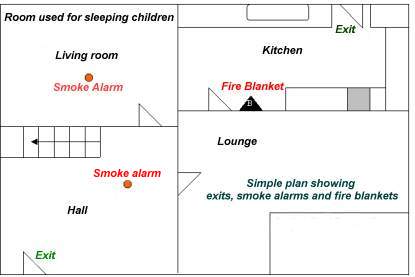
Complete the questionnaire on the next page to check that you have looked at all the possible hazards in your home and, where necessary, taken the appropriate action to lower the risk.
It is important to ensure that all the necessary fire safety measurers are in place. Remember the Fire Brigade will be asked to check your risk assessment and to ensure that the premises are suitable for childminding purposes.
|
RISK ASSESSMENT FOR INTENDING CHIDMINDERS |
Tick either yes or no below
|
1. Alarms |
Yes | No |
| Are children being allowed to sleep above or below the ground floor? | ||
| If the answer is yes, are smoke alarms fitted in all rooms the minded children will use and at all levels of the staircase? | ||
| Where more than one alarm is fitted, are they all fully interlinked? | ||
| If the children are not allowed to sleep and are only using the ground floor, have you at least one smoke alarm fitted in the hall or area in which the children will be minded? | ||
| Are the smoke alarms wired to the mains? | ||
| If the answer is no, are tamper-proof alarms with a lithium battery fitted? |
|
2. Escape Routes |
Yes | No |
| Was your property built after 1992? | ||
|
Are all routes out of the premises clear and easy to use and doors easy openable from the inside? |
||
|
If your escape route takes you into a garden or yard, is there a gate or other way out of the area to a place of total safety? |
||
|
If you have an open plan lounge and minded children sleep upstairs, are the upstairs windows fully openable and free from dangerous obstructions outside? |
||
|
Does the kitchen open into the area where children are to be minded? |
||
|
If the answer is yes, can you keep the children out whilst cooking? |
|
3. Reducing the Risk of Fire |
Yes | No |
| Are all heaters and fires protected by a suitable guard securely fixed? | ||
|
If you have gas taps, are they shielded to prevent tampering? |
||
|
Have you checked your upholstered furniture for tears and rips? |
||
|
Are all matches and lighters stored in a safe place? |
||
|
Have you checked electrical plugs and sockets to ensure they are safe and not over loaded? |
|
4. Fire Procedures |
Yes | No |
| Have you a method for calling the emergency services | ||
|
Have you organised a fire plan? |
||
|
Have you completed a simple drawing of your property as a part of your plan showing the alarms, fire blanket and escape routes? |
|
5. Firefighting Equipment |
Yes | No |
| Is a fire blanket fixed and available for use in the kitchen? | ||
|
Have you read the instructions on its use? |
Intending Childminders PDF file 171Kb
Produced by West Sussex Fire Brigade
This site is best viewed with Internet Explorer 4 or above at 800 x 600
Produced by West Sussex Fire Brigade Web Technology.
©Copyright West Sussex Fire Brigade 2000
West Sussex Fire Brigade Disclaimer
Information Provider
Paul Archer
Last Updated Saturday August 18, 2001 4:32 PM
