TURKISH EARTHQUAKE - AUGUST 1999
]
TURKISH EARTHQUAKE - AUGUST 1999
A Report by Divisional Officer Simon Webb WSFB
|
|
Turkish Earthquake:- Contd Cinarcik On arrival at Cinarcik the contingent was met by the Mayor of the town and directed to an area where there had been twelve apartments, with three totally collapsed and all the others partially affected in varying degrees. On arrival at the apartments three teams were immediately got to work on the rescue effort with the other two teams setting up a control point and base camp. The teams worked until about 1800hrs when they returned to the camp having assisted in various searches. Following liaison with other international teams at the location it became apparent that the rescue phase was reaching a conclusion and body recovery was now taking place. In this location it was primarily an Israeli team that were carrying out recovery operations with heavy plant. This posed particular problems for rescue teams as to work near them was very unsafe. A French team gave a very accurate assessment of the situation both at the apartments and also in the town of Cinarcik, and told us that they were staying on for two days to assist with body recovery. The contingent held a briefing and the consensus was that there were adequate resources in the town to carry out any rescues as a result of the body recovery operation. Contact was made with Istanbul to see if we could be re-deployed elsewhere for rescue purposes, the Field Commander had surveyed the area from Cinarcik along the coast for a distance of 60 miles and had assessed that we were no longer needed in the Yalova region. The Return The message from Istanbul was that we were not needed elsewhere and the following morning of the 21st we returned to Istanbul to meet up with the other contingent from the UK Fire Service Search and Rescue Team and the International Rescue Corps. Overnight accomodation was found close to the British Consulate in Istanbul from where we all returned to Heathrow in the evening of the 22nd August. During the rescue operation the UK deployment carried out three rescues and responded to between 150-200 requests for search assistance. Activities of Dr Ian McNeil UKFSSART
Dr McNeil's prime responsibility was the health and welfare of the UKFSSART personnel. One primary importance was the maintenance of adequate fluid intake, the temperature being 40°C. This involved regular checks on the fluids intake of all personnel and the encouragement to drink fluids when intake was poor. Additionally a very strict line was taken on protection from the sun with insistence that hats and shirts were worn at all times.
In addition a close watch on the physical health of all rescuers was maintained so that rest was taken when necessary. It was necessary to advise the team commander after 36 hrs of ceaseless activity that the personnel, and himself, were in danger of doing themselves harm. As a result he withdrew the teams for rest and recuperation. It was necessary on occasion to insist that men took rest breaks and meal breaks such was their zeal in the rescue effort. A close watch was also maintained on the emotional state of the team. During the deployment three men were counselled about stress and anxieties that they were feeling about the situation. Food and personal hygiene were also a concern however it was evident that the men were well briefed and did not require guidance in this area. A number of "paramedical skills" were available from the teams. It was clear however that the skills of some were in the circumstances more theoretical than actual and it was necessary to brief them on the principles of triage in mass casualty situations. A close liaison was maintained with these men who were keen to learn the principles.
In addition to the actual treatments and advise given Dr McNeil was available to immediately treat any serious injury to the team, this thankfully was not required. Care of local populous
Dr McNeil was often approached by locals for general health advice and support. This was given freely. Treatment to a Turkish soldier with laceration was given and an impromptu blood pressure clinic for the locals was held in Aiden Kent. All blood pressures were remarkable low!.
Care of rescued
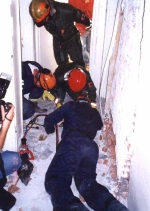
Dr McNeil was involved with one "live rescue". This was of a lady in her late sixties who was buried in the ground floor of a building that had collapsed its six stories above her. Dr McNeil was required to enter the rescue tunnel to monitor and advise on the urgency of rescue prior to extrication and was on hand to supervise the final handling of the extrication. The lady was then treated with an IV infusion, splintage and handed over to the Ambulance service for transport to hospital.
Care of the dead
Dr McNeil was required to confirm the death of large numbers of causalities both in situ and after removal from the buildings. On a number of occasions he was requested to dismember bodies for ease of extrication. This he did not in fact agree to do as on each occasion the access to the body was almost impossible and the degree of dismemberment too great.
Rescue effort
When not involved in the above tasks Dr McNeil was able to assist by fetching and carrying equipment, and by digging in the rubble and penetrating buildings with his Fire Service colleagues or helping with vibraphone and heat seeking cameras. Additionally general camp-side chores were done.
Conclusions The deployment of the United Kingdom Fire Service Search and Rescue Team was carried out swiftly and efficiently, the first contingent arrived in Turkey within 22 hours and the second within 48 hours of the earthquake. Once deployed in Turkey the teams had a limited timeframe to be effective in pure search and rescue terms, and within that timeframe the teams worked extremely effectively. The two contingents consisting of five teams each plus a Doctor and Dog Teams. With local assistance the Teams carried out between 150-200 searches of affected buildings and rescued 3 persons. The whole operation was carried out with only minor injuries to personnel, the health, safety and welfare of personnel was paramount.
This site is best viewed with Internet Explorer 4 or above at 800 x 600
|